You are viewing the Bozeman, MT location.


Every summer and early fall, Bozeman residents brace for the haze that drifts in from regional wildfires. Though picturesque on the horizon, that smoky veil carries a hidden threat—you’re breathing in microscopic particles known as PM₂.₅. These tiny enemies can sneak indoors, settling in carpets, infiltrating HVAC systems, and even passing through typical household filters. What can you do about wildfire smoke in Bozeman, MT? Here are our top tips.
Why Wildfire Smoke Makes Indoor Air Vulnerable
Wildfire smoke contains ultrafine particulate matter, volatile organic compounds (VOCs), and other pollutants. Because PM₂.₅ particles are smaller than 2.5 microns, they easily pass through cracks around windows and doors, small vents, and aging ductwork. Once inside, they can irritate your lungs, exacerbate asthma or allergies, and even burden the cardiovascular system. Kids, seniors, and those with chronic respiratory issues are especially at risk.
Whole-House Solutions for Wildfire Smoke Indoors
Rather than relying on portable air purifiers alone, consider whole‑house strategies engineered to protect your indoor environment from top to bottom.
1. Frequent HVAC Filter Changes
Your heating/cooling system is your first defense. During wildfire season:
- Use high-MERV filters (MERV 11–13): These are designed to trap particles the size of PM₂.₅. Standard fiberglass filters won’t cut it.
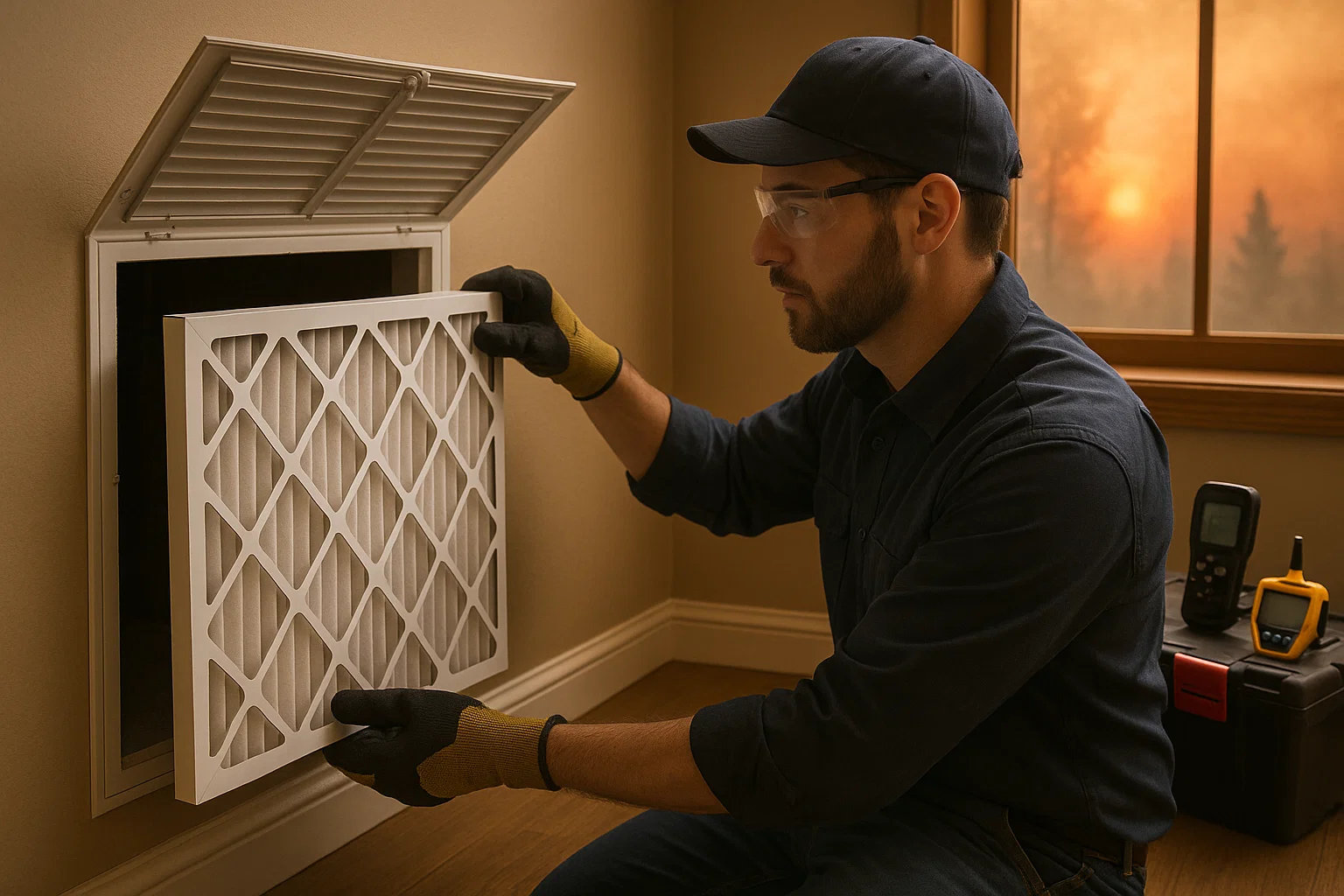
- Change filters every 4–6 weeks, or even sooner when smoke levels are severe. Keeping them fresh ensures airflow and prevents clogged filters from cycling tainted air back into living spaces.
- Ensure proper installation—no gaps or leaks where air can bypass the filter.
2. Whole-House Filtration or Purification Systems
Upgrading from basic filters to advanced systems can make a profound difference:
- MERV‑rated filter upgrades: Swap in MERV 13–16 filters compatible with your HVAC system. These capture >90% of PM₂.₅ particles.
- Media air cleaners: Installed in the air handler, these deep-bed filters provide enhanced particulate capture and easily last 12 months, offering smart money spent during wildfire season.
- Electronic air cleaners: Ionizing systems that charge airborne particles so they cling to collector plates rather than recirculating. They require periodic cleaning but offer strong PM capture.
- UV‑C systems: While primarily targeting pathogens, ultraviolet light can also reduce some VOCs when paired with advanced filtration systems.
3. Sealing and System Maintenance
A tightly sealed home supports purification efforts:
- Duct sealing: Use mastic or metal‑faced tape at joints to prevent unfiltered air intrusion.
- Weatherstripping: Keep windows and doors snug. Small gaps can undermine even the best filtration.
- HVAC maintenance: Schedule pro tune-ups to keep fans operating efficiently and filters seated correctly—both vital for maintaining clean airflow.
4. Smart HVAC Operation
- Run your system continuously (fan ON) during smoky days. Continuous circulation means steady filtration, keeping indoor air cleaner than outdoor levels.
- Set “recirculate” mode—avoid pulling smoky outdoor air in.
- Monitor air quality using real-time tools (like PurpleAir sensors). When outdoor AQI spikes, close dampers on fresh-air intake options.
Expert Help for Improving Indoor Air During Wildfire Season
Selecting the right whole‑house system—or ensuring your current HVAC setup is ready—can feel overwhelming. Our team of air‑quality experts in Bozeman is here to help. We’ll assess your home, recommend the ideal filtration strategy, guide system installations, and set you up for maintenance success. And when smoke season rolls in, we’ll be there to make sure your system is dialed in and performing at its best.
Investing in whole‑house air filtration isn’t just about comfort—it’s about protecting your health. With the right filters, systems, sealing, and expert support, Bozeman homeowners can breathe easier—even when the skies look smoky. Contact us today to schedule your Air Quality Consultation and take charge of your indoor air.
Frequently Asked Questions
Question: How does wildfire smoke get inside a home in Bozeman?
Answer: Wildfire smoke can enter through small cracks around windows and doors, vents, and leaky ductwork. Fine particles are tiny enough to move indoors even when the house seems sealed up. Once inside, they can settle into surfaces and continue circulating through your HVAC system.
Question: What kind of air filter works best for wildfire smoke?
Answer: Higher-efficiency filters are usually the best choice during smoke season. Filters in the MERV 11 to 13 range are commonly recommended because they are better at capturing fine smoke particles than standard fiberglass filters. The filter also needs to fit properly so air does not slip around it.
Question: How often should HVAC filters be changed during wildfire season?
Answer: During heavy smoke periods, filters may need to be replaced more often than usual. A good rule is every 4 to 6 weeks, or sooner if smoke levels stay high. Fresh filters help maintain airflow, improve filtration, and reduce the chance of recirculating contaminated indoor air.
Question: Should I run my HVAC fan when the outdoor air is smoky?
Answer: Yes, running the fan can help because it keeps air moving through the filter more consistently. On smoky days, many homeowners use the fan in ON mode and keep the system set to recirculate. That approach supports ongoing filtration instead of pulling in more polluted outdoor air.
Question: What can I do beyond changing filters to improve indoor air during wildfire smoke?
Answer: It helps to combine several steps: seal gaps around doors and windows, check ductwork for leaks, keep up with HVAC maintenance, and consider a whole-house filtration or air cleaning system. Monitoring outdoor air quality can also help you know when to tighten up the home and run filtration more aggressively.
Contact Ambient Air Solutions today for professional help with air quality and wildfire smoke in Bozeman, MT. Simplifying Heating & Cooling!